Introduction
Download this page as a Jupyter notebook
Why is force calibration necessary?
Optical tweezers typically measure forces and displacements by detecting deflections of a trapping laser by a trapped bead. These deflections are measured at the back focal plane of the beam using position sensitive detectors (PSDs).
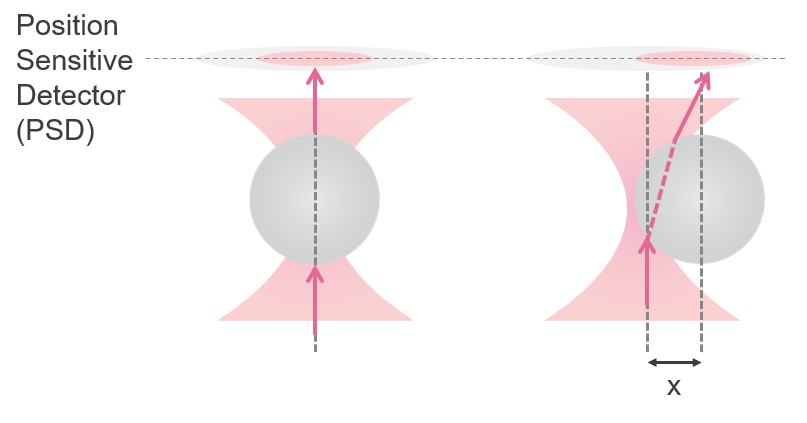
For small displacements \(x\) of the bead from the center of the trap, the relation between the force \(F\) pulling the bead back towards the center and the displacement can be assumed linear:
and
Where \(V\) is the position-dependent voltage signal from the PSD and \(R_d\) and \(R_f\) are the displacement and force sensitivity proportionality constants, respectively.
Force calibration refers to computing the calibration factors needed to convert from raw voltages to actual forces and displacements. The values we wish to calculate are:
Trap stiffness \(\kappa\), which reflects how strongly a bead is held by a trap.
Force response \(R_f\), the proportionality constant between voltage and force.
Distance response \(R_d\), the proportionality constant between voltage and distance.
Several methods exist to calibrate optical traps based on sensor signals. In this section, we will provide an overview of the physical background of power spectral calibration.
How can we calibrate?
We will start by building some intuition about the physical processes. Consider a small bead suspended in fluid (no optical trapping taking place). This bead moves around due to the random collisions of molecules against the bead. If we observe this motion over time, then we can see that it is a lot like the bead is taking aimless steps. This unimpeded movement is often called free diffusion or Brownian motion. How quickly the bead moves from the original position is characterized by a diffusion constant \(D\). When we look at the motion of the bead over longer time periods, then each random step contributes only a little to the overall movement. Because these steps are random, they don’t perfectly cancel out in the short term, and lead to a gradual drift. If there is no optical trap keeping the bead in place, then the bead slowly drifts off from its starting position.
One way to analyze this motion is to make a power spectrum plot of the bead’s position. This plot shows how much motion there is at different frequencies of movement. Lower frequencies correspond to longer time intervals. These are the time intervals we associated with the broader, slow movements of the bead. If we think about a bead moving due to random collisions, then we can expect that the bead will move more in these longer time intervals. This is why in the power spectrum of free diffusion, we see a lot more energy concentrated at these low frequencies, while the rapid jiggles at higher frequency contribute far less. The amplitude of this power spectrum is related to \(D\).

Now we introduce the optical trap, which pulls the bead back to the laser focus. The strength of this pull depends on how far the bead is from the focus, like a spring. Because of this, those motions which are larger will experience a strong pull from the trap and the motion will be limited. This damping of larger motions (at lower frequencies) manifests itself as sharp reduction of amplitudes in the power spectrum above a certain threshold. This leads to a plateau at low frequencies in the power spectrum of a trapped bead. The point at which the power spectrum transitions from a plateau to a downward slope is known as the corner frequency \(f_c\).
Important takeaways
The spectrum of bead motion in a trap can be characterized by a diffusion constant and corner frequency.
At low frequencies, the trapping force dominates and limits the amplitudes, while at high frequencies the drag on the bead does.
Mathematical background
Neglecting hydrodynamic and inertial effects (more on this later), we obtain the following equation of motion:
where \(x\) is the time-dependent position of the bead, \(\dot{x}\) is the first derivative with respect to time, \(\gamma\) is the drag coefficient and \(F_\mathrm{thermal}(t)\) is the thermal force driving the diffusion. This thermal force is assumed to have the statistical properties of uncorrelated white noise:
where \(k_B\) is the Boltzmann constant, \(T\) is the absolute temperature, and \(\xi(t)\) is normalized white noise.
We can rewrite this in terms of the diffusion constant by using Einstein’s relation \(D = k_B T / \gamma\):
with the diffusion constant \(D\). Note how this constant depends on the drag coefficient.
The expected power spectrum of such free diffusion is given by the following equation:
We can plot this spectrum for different diffusion constants:
f = np.arange(100, 23000)
for diffusion in 10**np.arange(1, 4):
    plt.loglog(f, diffusion / (np.pi**2 * f**2), label=fr"D={diffusion} $\mu m^2/s$")

plt.xlabel("Frequency [Hz]")
plt.ylabel(r"Amplitude [$\mu m^2$/Hz]");
plt.legend()

Here, the vertical axis represents a displacement amplitude while the horizontal axis represents frequency. Observe how, for free diffusion, the low frequencies have larger amplitudes than the high frequencies.
Next, consider the effect of the optical trap on this diffusion. The optical trap will pull the bead back towards the focus of the beam. As such, the trap will constrain motion, limiting in particular the high amplitudes. In other words, we expect this effect to be more prominent at low frequencies as they have larger amplitudes. Compared to the previous spectra, this should result in a plateau at the low frequency end of the spectrum. Still neglecting hydrodynamic and inertial effects, one can write down the differential equation for a trapped bead.
Note that we now have a few additional parameters, namely the drag coefficient \(\gamma\) and the trap stiffness \(\kappa\). From this, the following power spectrum can be derived:
Note how we’ve defined a corner frequency \(f_c\) from the trap stiffness and the drag coefficient. When plotting this equation for various values of the corner frequency, we see the expected plateau:
plt.figure(figsize=(12, 4))
plt.subplot(1, 2, 1)
diffusion, corner_freq = 1000, 1000
for diffusion in 10**np.arange(1, 4):
    plt.loglog(f, diffusion / (np.pi**2 * (f**2 + corner_freq**2)), label=fr"D={diffusion} $\mu m^2/s$")

plt.xlabel("Frequency [Hz]")
plt.ylabel(r"Amplitude [$\mu m^2$/Hz]");
plt.legend()

plt.subplot(1, 2, 2)
diffusion, corner_freq = 1000, 1000
for corner_freq in [1000, 5000, 10000]:
    line, = plt.loglog(
        f, diffusion / (np.pi**2 * (f**2 + corner_freq**2)), label=f"$f_c$={corner_freq} Hz"
    )
    plt.axvline(corner_freq, color=line.get_color(), linestyle="--")

plt.xlabel("Frequency [Hz]")
plt.ylabel(r"Amplitude [$\mu m^2$/Hz]");
plt.legend()
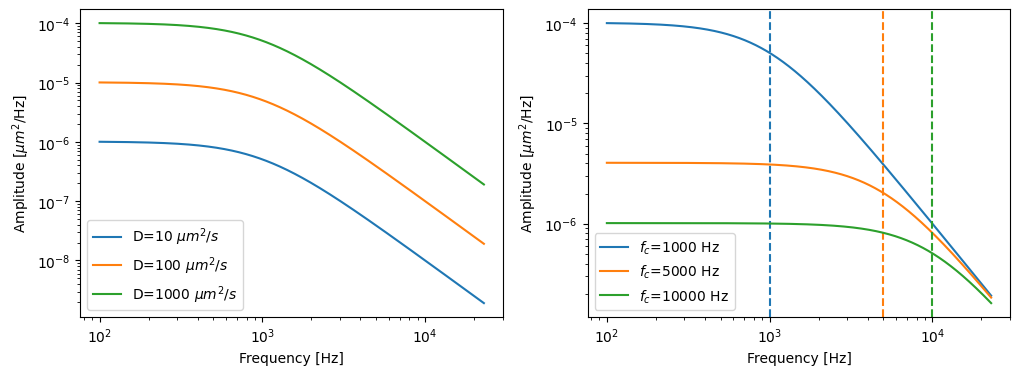
The simple model plotted here is known as the Lorentzian model and it is only a good approximation for small beads (more on that later). We see from the plot that a stiffer trap constrains diffusion more strongly (leading to a wider plateau) and a higher corner frequency. In practice, we wish to fit this spectrum in order to determine the corner frequency which in turn provides information on the trap stiffness once the drag coefficient is known.